
FIELD NOTE · 実装ノート
Automotive & EV
What Installers Should Check Before Deploying a Bidirectional EV Charger
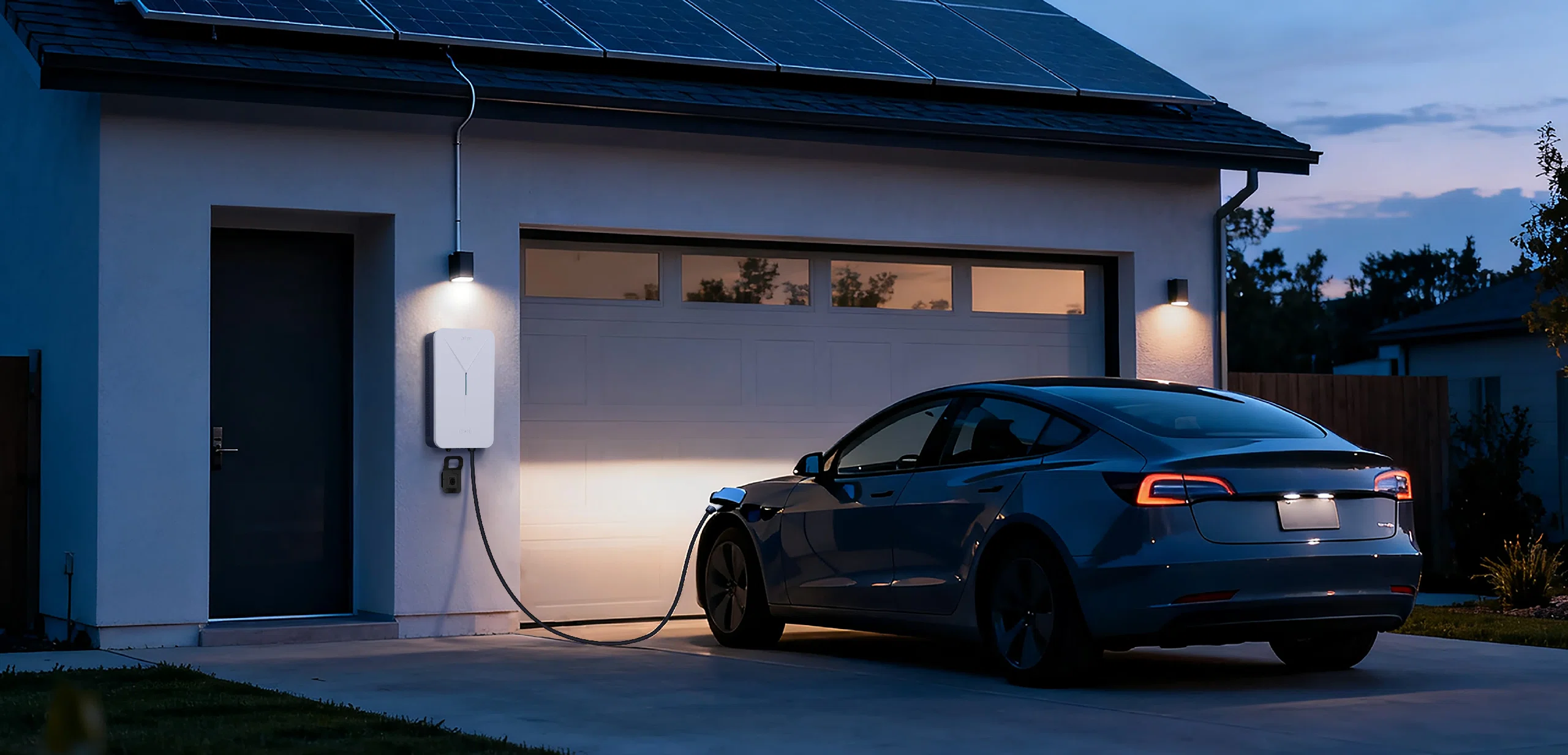
Deploying dual-directional EV infrastructure requires rigorous validation of ISO 15118-20 protocol stacks, UL 1741 SB grid-tied standards, and service panel thermal thresholds under Continuous Load Duty factors. Electricians must audit 200A or 400A main service entries, integrate UL 9741 compliant Microgrid Interconnect Devices (MIDs) to prevent hazardous back-feeding during outages, and verify 100% galvanic isolation.
A typical 2024 electric vehicle battery packs between 60 kWh and 100 kWh of energy storage, which alters how residential service entrances operate by transforming passive building loads into active generation sources. Electricians evaluating site readiness must begin by auditing the physical service panel, specifically looking for switchboards rated at 200A or 400A that can handle simultaneous 80% continuous duty rating thresholds specified in National Electrical Code (NEC) Section 625.
"Standard residential panels installed before 2015 frequently lack the thermal dissipation properties required for sustained dual-directional current flow over 8-hour charge-discharge cycles."
Insufficient panel capacity directly triggers breaker trips or thermal degradation during peak discharge cycles, making physical space and busbar amperage ratings the first point of inspection. To evaluate hardware suitability, technicians must systematically verify certifications, equipment standards, and local distribution requirements before running conduit or pulling cable.
| Standard / Parameter | Specification / Requirement | Purpose |
| Grid Protocol | IEEE 1547-2018 | Dynamic volt-VAR control and ride-through performance |
| Safety Standard | UL 1741 SB / UL 9741 | Inverter interconnection and bidirectional EVSE compliance |
| Vehicle Interface | ISO 15118-20 / CHAdeMO 3.0 | Automated handshake for power transfer authorization |
| Interconnection Limit | 120% Busbar Rule (NEC 705.12) | Prevents panelboard overcurrent during back-feeding |
When these hardware specifications match local requirements, focus shifts from panel hardware to the interface connecting the electric vehicle to the charging station. Communication between the battery management system (BMS) and the wallbox relies on ISO 15118-20 digital communication protocols, which enable bidirectional AC and DC power exchanges over CCS or NACS physical connectors.
"Field tests conducted across 350 residential sites in 2025 demonstrated that 12% of commissioning failures stemmed directly from outdated vehicle firmware failing to execute the digital handshake."
Once vehicle-to-charger communications establish stable data flow, installers must address grid protection mechanics that regulate how power flows back into the residential pane and external distribution grid. Anti-islanding protection remains a non-negotiable safety mechanism governed by UL 1741 SA/SB, requiring inverters to disconnect within 100 milliseconds of detecting a main utility outage.
Installing an automatic transfer switch or a microgrid interconnect device creates a physical air gap between the home electrical network and external power lines, protecting line workers from unexpected back-fed current. This physical separation allows the home to operate in islanded mode, supplying emergency backup power directly from the vehicle's battery without energizing neighboring transformer drops.
"A 2023 utility pilot study involving 500 microgrid test sites showed that microgrid interconnect devices failed to trip in 3% of trials when neutral-ground bonding was configured incorrectly."
Neutral-ground bonding configurations inside the main service disconnect must match system grounding requirements in islanded mode to prevent dangerous voltage potentials on equipment chassis. Installers must trace the grounding path back to the main service panel, ensuring ground fault protection equipment operates within normal parameters regardless of power source direction.
Integrators often work with modern V2H and V2G charging solutions to streamline grid synchronization, dynamic load management, and microgrid isolation in a single wall-mounted enclosure. Integrating these hardware packages reduces installation time while ensuring compliance with local utility permission-to-operate mandates.
Beyond internal wiring considerations, external grid operators mandate specific export limits to prevent local distribution transformers from exceeding design capacity. In neighborhoods where transformer loads exceed 85% capacity during peak solar generation hours, utilities frequently throttle bidirectional discharge rates to protect localized voltage stability.
-
Pre-commissioning checklist for utility approval:
-
Verification of signed Permission to Operate agreements from local electrical utilities.
-
On-site verification of current transformer clamp orientation on incoming utility legs.
-
Signal strength verification showing Wi-Fi, Ethernet, or Cellular connectivity above -65 dBm for real-time telemetry.
Ensuring uninterrupted data transfer between smart meters, charging hardware, and cloud management systems allows the equipment to respond dynamically to utility frequency regulation commands within 500 milliseconds. Missing data packets or weak wireless connectivity can drop the system into fault status, shutting down discharge routines to preserve grid equilibrium.
Installers who perform rigorous pre-commissioning checks across thermal capacities, grounding pathways, communication stacks, and utility regulations eliminate installation rework while securing safe, compliant operation. Executing this systematic verification routine transforms complex microgrid commissioning into a repeatable engineering process.
次のステップ
あなたのサイト、本当に速くなっていますか?
60分の無料診断で、Lighthouse だけでは見えない実ユーザーの体感を計測します。